Sunday, 10 January 2016

Role of international organisations in market failure

Common access resources are of 2 types, private and public. The private resources are rivalrous in nature, where as public goods are non rivalrous. These public resources are open for everyone to use, which may result in their exploitation and overuse. The repercussions of this often not only affect the area that the resource is exploited in, but also in the surrounding areas, resulting in deterioration of the earth. For example, the World Health Organisation reported in 2011 that Delhi had exceeded the maximum pollution limit by at least 10 times. This not only affects Delhi but also the places surrounding Delhi.
The preservation of common access resources is challenging, as no one owns these resources, hence there is no one person that can be blamed for its destruction. The ozone layer, for example, is being depleted. However, no single country can be blamed for it as nobody owns it. Hence, preserving these resources is becoming increasingly difficult.
International organisations have been found to be a successful solution so far, hence they play a very important role in the preservation of common access resources. A great example of this is the Montreal Protocol that was signed in 1987. The attached video talks about how it worked and its success. One of the most recent forms of action to save a common access resource was the Paris Summit in 2015, which deals with the issue of the increasing temperature of the earth, and how we can prevent the earth from over heating over a long term.

Hence, because there is no private owner of common access resources and every user wants to exploit it to their maximum potential to increase their self gain, international organisations play a crucial role in protecting and preserving such resources.

Works cited:
"International Organisations and Market Failure." Econclassroom.com. N.p., n.d. Web. 9 Jan. 2016.

"Role of International Organisations." Youtube.com. N.p., n.d. Web. 9 Jan. 2016.


"International Organisations and Market Failure." Ncbi.com. N.p., n.d. Web. 9 Jan. 2016.

Tragakes, Ellie. "Market Failure." Economics for the IB Diploma. Cambridge: Cambridge UP, 2009. 124-30. Print.


"International Organisations and Market Failure." Youtube.com. N.p., n.d. Web. 9 Jan. 2016.


Asymmetric Information and Adverse selection:


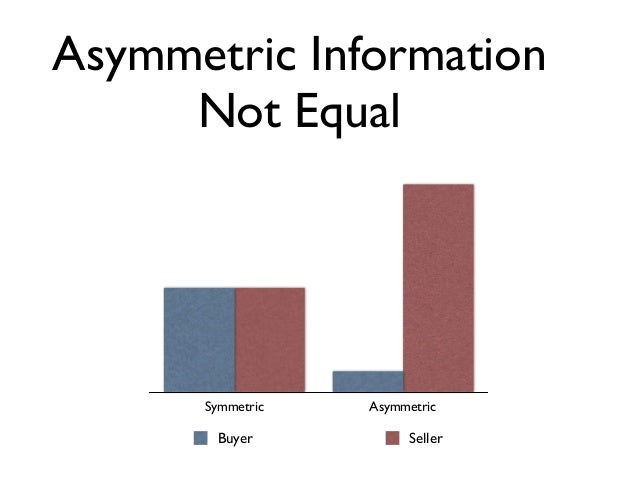
Asymmetric Information: it is a situation in which one party has more information compared to the other. It often occur when the seller knows more than the buyer, and vice versa. This could be seen as a potential problem, as one party can take advantage of the other party’s lack of knowledge. Asymmetric information is seen as two basics, Moral Hazards and Adverse selection. 

The video below is from MRUniversity, it explains the basics of Adverse Selection.


Thus Adverse selection can be defined as a phenomenon where the insurer is confronted with the probability of loss, due to a risk that wasn't factored in at the time of sale. This occurs when the insured people deliberately hide certain pertinent information from the insurer. The information may be of critical nature as these help in ascertaining the risk profile of the insured and accordingly help in determining the correct premiums. 
However, non disclosure of the information which impacts the life of the insured can lead to faulty determination of premiums and may lead to loss of the insurance company as the insurer will find it difficult to do a prudent asset liability management owing to payment of more claims compared to the receipt of premiums.

The uneven knowledge between the buyers and sellers causes the price and quantity of the goods or services in a market to shift. This results in "bad" products or services being selected. For example, if a bank set one price for all of its checking account customers it runs the risk of being adversely affected by its low-balance and high activity customers. The individual price would generate a low profit for the bank.

The Death Spiral of Adverse Selection:


Methods to reduce the problem of Adverse Selection:

Government Policies- Private insurance companies usually protect themselves against adverse selection by offering a range of policies where the lower the cost of the insurance, the higher the out-of-pocket payments. 

This offers people choice, so that those who have a low risk of getting sick can buy a low-cost policy with higher out-of-pocket payments , while higher-cost policies with lower out-of-pocket payments can be selected by people who believe that they have a higher risk of getting sick.
To avoid adverse selection, firms need to try and identify different groups of people. This is why there are health insurance premiums for people who smoke and obese people.Insurance firms will charge different rates to consumers depending on factors, such as age.This means that those who are at most risk will likely have higher premium rates.

Tax- Another way for governments to deal with the problem of adverse selection is through tax funded social health care services. Although this may seem as a partial solution, it faces a potential problem in controlling the costs of providing health care and puts a huge burden on the government regarding the budget.

Citations:

"Asymmetric Information Definition | Investopedia." Investopedia. N.p., 19 Nov. 2003.  Retrieved 8 Jan. 2016

“Asymmetric Information: Adverse Selection and Moral Hazard.” Boundless Economics. Boundless, 21 Jul. 2015. Retrieved 9 Jan. 2016

Pettinger, Tjvan. "Adverse Selection Explained." Economics Help. N.p., 28 Nov. 2014.  Retrieved 8 Jan. 2016

Freidman, Ari. “Understanding The Individual Mandate’s SCOTUS Pivot Points.” Understanding The Affordable Care Act.” Nora Becker. Retrieved 9 Jan. 2016


Saturday, 9 January 2016


role of international organisation


Common access resources like private goods are rivalrous but like public goods are non excludable. Thus common access resources are consumed without any payment, giving rise to a significant decrease in environmental stability. The depletion of common access resources leads to negative externalities, like the smog in Beijing and Delhi. This is why common access resources is a form of market failure.
Sustainability has become a recurring problem in the world today, it's meaning refers to preserving common access resources over time. The economy strives to improve their output while environmental goals consist of preserving the environment, to prevent the depletion of resources.
'The role of international organisation' is a solution to common access resources, as no one 'owns' these common access resources no country can be solely blamed for the depletion of these resources. An example of a common access resource is the ozone layer, at this point in time, china is the world's most polluting country. But, all governments can't expect china to solely make an effort in preserving the environment, as all countries have contributed to the depredation of the ozone layer.
Therefore, an initiative to protecting the environment has to be made. The Montreal protocol, Kyoto Protocol, EU ETS, and more recently the Paris summit, are examples of methods to preserve the environment. The montreal protocol has been the most successful one while the Paris summit of 2015 is the most recent one. It focuses on capping the world temperature and making sure it doesn't increase by more than 2 degrees. 196 countries have signed a new agreement for tackling climate change with long term approaches. 
Therefore, the role of international organisations is to foster cooperation between all governments, of the world, to consolidate a foolproof plan to save the world, and preserve common access resources. 


bibliography 


1.Rice, Howard C. "Thomas Jefferson's Paris." (2015): n. pag. Rebecca Willis. Web.
2. "Paris Climate Change Summit 2015: 'the near Impossible Task'" YouTube. YouTube, 30 Nov. 2015. Web. 10 Jan. 2016.
3. Geoffrey, Jefferson, Clemens, and Gabriel. "Common Access Resources." Prezi.com. N.p., 31 Oct. 2012. Web. 10 Jan. 2016.


Moral hazard occurs when one party gets involved in a risky event knowing that the deal is already done and the cost would be faced by the other party of the deal. Moral hazard is a result of asymmetric information and is usually related to the insurance market.
However this picture takes an interesting aspect of the health insurance market. Generally, public who tend to take health insurances, start using medical facilities to a much greater extent than what they previously did.  This is because now they know the insurance company will pay for the major chunk of the amount. This also makes it convenient for them because now they wouldn’t be very worried about the financial hit they would get if they fell severely sick because the insurance is their backbone.
However this could be taken in a negative way because now the people who’ve taken insurance, use medical facilities much more without paying for it, but this additional care is actually costly to produce. Hence this could be a disadvantage for the insurance company and is reflected by the cartoon. Because it says that now the “insurance only covers chuckles, snickers and giggles”. This shows how the insurance companies have to narrow down their policies too, so that the people cannot overuse or create a negative effect.


                                                                                                           Yasha Mehta
Asymmetric Information and Moral Hazards

Asymmetric Information is a situation in which one member has more information than the other during a tranaction. This often happens when either the buyer or the seller have more information about a particular thing than the other. Theoretically, this is a negative situation because one party can take advantage of the other party's lack of knowledge.1

Problems faced by Assymetry of Information

1. Moral Hazard- unethical conduct that benefits from information asymmetry AFTER a deal. For example, if Mr. X  has 
a life insurance, they are more likely to drink and drive and act carelessly.


2. Adverse selection- unethical conduct that benefits from information asymmetry BEOFRE a deal. For example, a person who is not keeping good health os more likely to take a life insuarnce than the person who is fit

”Moral hazard is a situation in which one party gets involved in a risky event knowing that it is protected against the risk and the other party will incur the cost.”
                                    -The Economic Times

 Examples:
1) a person with insurance against car burglary may be careless about securing their car because the negative penalties of automobile burglary are now the concern of the insurance firm. A party makes a choice about how much risk to take, while another party bears the costs if things go badly, and the party protected from danger behaves in a different way from how it would if it were fully visible to the danger.2

2)  When you are not insured, you take extra care by brushing and flossing tiwce a day because you are aware that a dental problem is going to cost you a fortune. However, you manage to get a dental insurance through a new job and your incentive of taking care of your teeth reduces because of the insurance. The insurance company still thinks you are taking good care of your teeth and gums and if you have any problem, you’ll go to the dentist to fix it. Therefore, you have information that the insurance company does not, and if the firm doesn’t get to know of this soon, they are risking the fact of not charging you a high premium. It is more likely that customers like you would put them out of business.3

Solutions:

1.   Regulations:
Governments can pass laws to ensure moral ethics and security characteristics that must be
maintained by both the parties.

Problems faced:
-Since the population is massive, legislations are time consuming and slow down financial activities.
·         -These activities are expensive and have great opportunity costs.
 
2. Provision of Information: 
Governments may openly stream data to customers, or force manufacturers to provide data, therefore shielding customers in their buying choices.
Problems faced:
  • There may be loops in the data and hitches in the gathering and opportunity cost of the data.
  • It is not constantly probable to eliminate asymmetric information completely, because of some secreted data.


CITATIONS:
1 "Asymmetric Information Definition | Investopedia." Investopedia. N.p., 19 Nov. 2003. Web. 09 Jan. 2016.
2 Wikipedia. Wikimedia Foundation, n.d. Web. 09 Jan. 2016.


3 "Moral Hazard in Economics: Definition & Examples." Study.com -Introduction to Buisness. N.p., n.d. Web. 09 Jan. 2016.

Friday, 8 January 2016

Moving Ahead With Economics: The Reasons of Market Failure

International Organization in Sustainability

Countries, organizations and individuals are becoming selfish and manipulative day by day. In such a world the resources such as the common access resources are becoming more vulnerable. Common access resources are those resources which are rivalrous perhaps non-excludable. The main drawbacks of such resources are that they are free in nature and nobody can deny its usage although its overuse makes the resource rivalrous; for example, air, fish in the open seas, wildlife etc. The over-exploitation of these resources is paced up in today’s world which is adversely effecting the environment. Defiantly there is development seen due to this trend but the highlight is that this development is not sustainable. Researches and awareness programmes have successfully triggered this into everybody’s mind that this carefree and careless behavior of us is ultimately causing harm to ourselves and the mother earth has already started giving ultimatums about the outcomes of such activities of humans by showing trailers of the future disaster that may definitely happen if this recklessness is continued. This alarming problem demands strong international co-operations.International organizations are actively showing interest in such handshakes because it is a binding case of environment. There are a lot of agreements signed, laws passed and measures taken in such a short while (after the issue being introduced) which is quite an achievement for this world. Many of such treaties have been  successful over the years, like the Montreal Protocol (1987-1989)  but a lot of them have also been unsuccessful because of the mere fact that countries are organizations involved in these actions are selfish and they try to derive individual benefits out of such sensitive goals which is petty. For example the Kyoto Protocol of 1997-2012.

The most recent example is the Paris Climate Change UN Conference 2015. The Paris UN Climate Conference represents an historic opportunity to put the world on course to meet the climate change challenge. The world needs a new model of growth that is safe, durable and beneficial to all. COP21 seeks to deliver a clear pathway with short and long term milestones, and a system to help us measure and increase progress over time until we get the job done.  The conclusions yet are positive.[1]


[2]
Ø This speech by Obama (president of the USA) gives us some hope  because it’s good to see that such developed countries are also co-operating.
[3]
Ø The statement of the Russian President Vladimir in this video about the injustice to the developing countries is a very good because lack of equality is one of the most debated topics in such issues.
All in all such agreements are the need of hour and the only solution as of now for the ecology and thus we shouldn’t stop until we find a better solution to tackle such loop holes.

-Shalini Sinha

Bibliography-
[1]- Figueres, Christiana. United Nations Framework Convention on Climate Change. UNFCC,n.d.Web.9Jan.2016.<http://unfccc.int/meetings/paris_nov_2015/meeting/8926.php>.
[2]- COP 21: Obama's full speechat Paris conference - live
  [3]- COP 21: Putin's Full Speech on Russia Climate Change Reform - Live. Perf. Vladimir. YouTube. Euronews, n.d. Web. 08 Jan.2016. <https://youtu.be/Y4R28THutKI>.

Thursday, 7 January 2016


D. Asymmetric Information and Adverse selection. 


What is asymmetric information?

A situation in which one party in a transaction has more or superior information compared to another. Potentially, this could be a harmful situation because one party can take advantage of the other party's lack of knowledge.
Asymmetric information can be further divided into moral hazards and adverse selection.


What is adverse selection?

According to the Economic Times, adverse selection is defined as 'a phenomenon wherein the insurer is confronted with the probability of loss due to risk not factored in at the time of sale. This occurs in the event of an asymmetrical flow of information between the insurer and the insured.’

Adverse selection occurs when the insured deliberately hides certain pertinent information from the insurer. The information may be of critical nature as these help in ascertaining the risk profile of the insured and accordingly help in determining the correct premiums. However, non disclosure of the information which impacts the life of the insured can lead to faulty determination of premiums and may lead to loss of the insurance company as the insurer will find it difficult to do a prudent asset liability management owing to payment of more claims compared to the receipt of premiums.

How does adverse selection contribute to market failure?
When an insurance provider offers a policy, it must structure its contracts to compensate for high-risk individuals, which will create an extra disincentive for low-risk individuals to buy insurance they might need.
This implies that low-risk individuals have a hard time finding fair prices for their insurance needs. Hence, low-risk consumers drop out of the insurance market because they are unwilling to pay Rs. 300,000 for a policy they only value at Rs. 75,000, for instance – the market experiences a deadweight loss in efficiency because suppliers and consumers are no longer coordinating optimally. This deadweight loss and and an entire sector of healthy low-risk consumers missing out from insurance policies leads to market failure.
How can it be reduced?

To deal with the problem of adverse selection, the government can intervene. Intervention can be in the form of direct provision of health care services (fuelled by tax revenues). This ensures that everyone in the country gets health care insurance indiscriminately. Alternatively the government can provide insurance only to vulnerable groups or they can provide social health insurance. Recently, USA tried to implement ObamaCare. 
One of the major aims of Obamacare was to help these individuals to get health insurance

through expanding Medicaid eligibility and offering cost assistance through health insurance marketplaces. By the end of open enrollment in 2014, less than 13% of Americans were uninsured. The issue with governmental provisions is the opportunity cost involved. Providing cheap or free health care to all or most citizens is a huge burden on government and makes it hard for the government to control costs.

Citations:

1. "Asymmetric Information Definition | Investopedia." Investopedia. N.p., 19 Nov. 2003. Web. 07 Jan. 2016. <http://www.investopedia.com/terms/a/asymmetricinformation.asp?layout=orig>.

2. Pettinger, Tjvan. "Adverse Selection Explained." Economics Help. N.p., 28 Nov. 2014. Web. 07 Jan. 2016. <http://www.economicshelp.org/blog/glossary/adverse-selection/>.

3. Spaulding, William C. "Information Asymmetry: Adverse Selection and Moral Hazard." This Matter. N.p., n.d. Web. 7 Jan. 2016. <http://thismatter.com/money/banking/information-asymmetry.htm>.

4. "What Is ObamaCare | What Is the Affordable Care Act?" Obamacare Facts. N.p., n.d. Web. 07 Jan. 2016. <http://obamacarefacts.com/whatis-obamacare/>.


-Tarini Gandhi
11 HL1

Tuesday, 5 January 2016

Asymmetric Information and Moral Hazards


C. Asymmetric information and Moral Hazards


What are moral Hazards?

Moral Hazards are when a firm decides to involve itself in a risk event, knowing that if this event will fail the firm wont incur the risk  but another party will. 

Asymmetric information:

Information Asymmetry basically deals with the study of decisions taken in a transaction, where one firm has better or more information than another. 

Asymmetric information in insurance

Another example of asymmetric information is with regard to insurance. When insuring a good the insurer is uncertain how well the customer will look after a piece of property. For example, if a consumer was careless with locking his bike, the insurer would not want to insure it. This problem can lead to the related problem of adverse selection.

To overcome asymmetric information in insurance, insurers will give big discounts for ‘no claims bonuses’ this is the best way of gaining better information about ‘careful’ and ‘unlucky’ consumers.

Monday, 4 January 2016

The Reasons of Market Failure

Market Failure
A. Common Access Resources and sustainability
B. The Role of the International Organisation in Sustainability
C. Asymmetric information and Moral Hazards
D. Asymmetric Information and Adverse selection. 


Post your essays, views and comments with the help of videos and presentation.

Due Date : Sunday, January 10th 2016